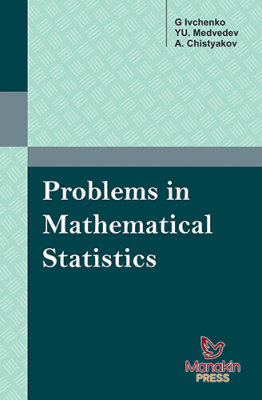


Problems in Mathematical Statistics
₹595.00
 G. Ivchenko | Y.U. Medvedev | A. Chistyakov | Category: Mathematics
Binding Type: Paperback Binding
Book DetailsISBN: 9789386221841
YOP: 2018
Pages: 282Order also on
The book covers all the traditional topics in modern statistical theory and is designed for students at technical colleges and universities who have mathematical statistics as an obligatory course. Problems on computer simulation of random variables in order to obtain the data for statistical interpretation have been included. Any “theoretical” problem which contains a statistical algorithm for data analysis can be used (with the appropriate (practically infinite) choice of the model parameters) to formulate a “practical” problem. At the first stage the original data should be simulated using either published tables of random numbers or special computer programs. Then, by Interpreting these “experimental” results according to the algorithm in question, the student can compare the theoretical hypothesis with the original parameters which are known as they were used when the sample was simulated.
Chapter 1- Principles of Statistical Description. Sampling Characteristics and Their Distributions
Chapter 2- Estimation of Distribution Parameters
Chapter 3- Tests of Statistical Hypotheses
Chapter 4- Linear Regression and the least Squares Method
Chapter 5- Decision-Functions
Chapter 6- Statistic of Stationary Sequences
The book covers all the traditional topics in modern statistical theory and is designed for students at technical colleges and universities who have mathematical statistics as an obligatory course. Problems on computer simulation of random variables in order to obtain the data for statistical interpretation have been included. Any “theoretical” problem which contains a statistical algorithm for data analysis can be used (with the appropriate (practically infinite) choice of the model parameters) to formulate a “practical” problem. At the first stage the original data should be simulated using either published tables of random numbers or special computer programs. Then, by Interpreting these “experimental” results according to the algorithm in question, the student can compare the theoretical hypothesis with the original parameters which are known as they were used when the sample was simulated.
Chapter 1- Principles of Statistical Description. Sampling Characteristics and Their Distributions
Chapter 2- Estimation of Distribution Parameters
Chapter 3- Tests of Statistical Hypotheses
Chapter 4- Linear Regression and the least Squares Method
Chapter 5- Decision-Functions
Chapter 6- Statistic of Stationary Sequences
| Weight | 0.365 kg |
|---|---|
| Dimensions | 21.9 × 14 × 1.4 cm |
| yop |
2018 |
| subject-category |
Mathematics |
| isbn |
9789386221841 |